Schienen-Control Newsletter Schienen-Control
At the end of June 2023, Schienen-Control published Schienen-Control annual report. It contains observations on the rail transport market in 2022.
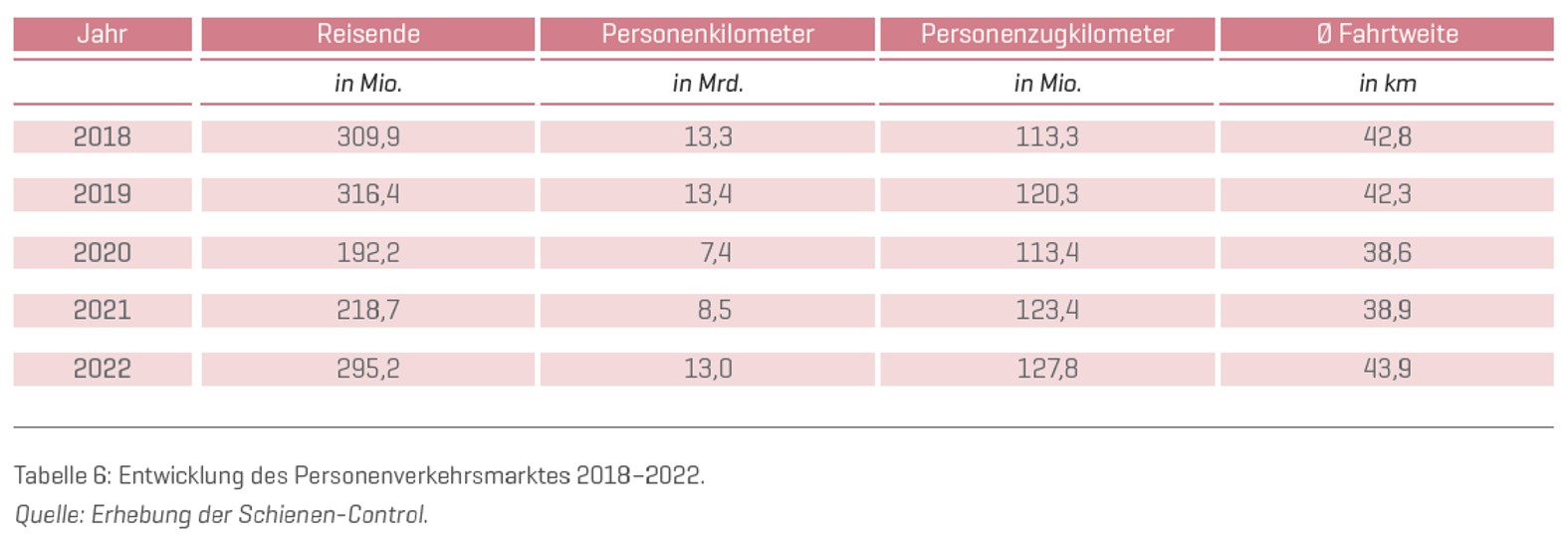
In passenger transport, all performance indicators rose sharply in 2022. This continued the growth trend seen in the years prior to 2020. Due to an increase in passenger numbers, passenger kilometers traveled rose by more than 50 percent. The decisive factor here was the phasing out of measures against the COVID-19 pandemic and the resulting return to workplaces and schools. At the same time, rail services were expanded to record levels through additions to long-distance services, general increases in the frequency of trains, and extensions to operating hours in local transport. The average distance traveled per passenger was 43.9 km in 2022 – a record figure.
The main indicators for rail freight transport still show good growth rates for the first half of the year. In the second half of the year, the indicators are largely stagnating. For 2022 as a whole, this results in a contrasting trend in the key figures: on the one hand, transport performance (net ton-kilometers, gross ton-kilometers) increased in the low single-digit range, while on the other hand, volume (net tons transported) declined to a similar extent. Market data showed slight growth rates of 1.4 and 2.4 percent for both net and gross ton-kilometers traveled. In contrast, net tons transported declined slightly by 0.8 percent in 2022.
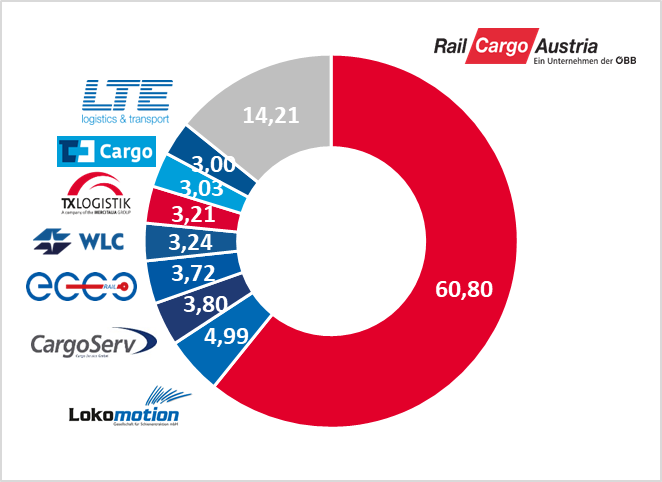
Rail Cargo Austria's market share declined once again (60.8 percent), while privately owned railways reached a new high with a cumulative share of 24.7 percent.
Although there were comparatively few restrictions on international goods traffic in 2022 compared to previous years, other factors caused problems for rail freight transport. In addition to the shortage of qualified personnel, the bottleneck in available rolling stock (affecting both locomotives and freight cars), which is now widespread throughout Europe, has further intensified. The massive increase in traction current prices from the end of February 2022 triggered by the war in Ukraine and the resulting rapid rise in the general price level also posed considerable challenges for railway companies and rail freight transport. Last but not least, extensive infrastructure work and construction-related diversions in neighboring countries (especially Germany) also had an impact on the planning and execution of transport operations. Due to all these circumstances and the renewed decline in mineral oil prices, the pressure to shift freight transport to road increased.
EVU with positive feedback on the location
With 65 companies, more than ever before were authorized to operate trains on the ÖBB network. A total of 86 railway companies (infrastructure, integrated, and pure railway transport companies) were registered in Austria in 2022.
A survey of railway companies conducted by Schienen-Control an overall very positive assessment of the Austrian market. The highest ratings were given to train path allocation, the language skills of railway staff, and the quality of training facilities. The industry saw room for improvement in terms of competition from other modes of transport, inconsistent EU-wide regulations on the issuance of safety certificates, and official requirements in the area of human resources. Overall, the domestic railway market received better ratings than the foreign market.
Regulatory work for railway companies in 2022
In the reporting year 2022, the Schienen-Control (SCK) initiated proceedings in the areas of service facilities and services, track access charges, and access to railway infrastructure, thereby contributing to the further liberalization of the rail transport market.
An important task of Schienen-Control to mediate in route conflicts between the infrastructure operator and transport companies. In 2022, two proceedings were conducted in this regard—on the one hand, the RailJet stop in Vöcklabruck was secured, and on the other hand, diversions were agreed upon in a discussion between the licensing authority, the regulatory authority, and the railway transport company, so that traffic between Vienna and Burgenland could continue despite construction work in the summer of 2023.
The Schienen-Control conducted proceedings concerning shunting services in Tyrol. A railway undertaking (RU) claimed that the service operator had refused to provide services it required. Schienen-Control mediate between the RU and the service operator and find a solution that was satisfactory to both parties.
In the 2022 reporting year, the Schienen-Control conducted proceedings concerning the station charges of Austria's largest station operator. In the course of the proceedings, the station operator developed a demarcation model that regulates the demarcation of service facility assets from those of the minimum access package.
A procedure concerning wagon inspector services revealed that railway companies were being treated unequally with regard to clearing fees. Following an investigation by the Schienen-Control , a decision was issued declaring the fees for wagon inspector services to be invalid.
The Schienen-Control conducted proceedings concerning the obligation for railway undertakings to transmit their train and wagon data ( minimum operational data) to the railway infrastructure operator. This transmission was possible for a railway undertaking in rail freight transport via an interface, but not for other market participants. In the course of the proceedings, the infrastructure company ensured that it would take over the competitor's data interface and make it available to all railway undertakings on a non-discriminatory basis until a successor system was put into operation.
You Schienen-Control the complete annual report of Schienen-Control on our website.
Market update September 2023
Challenges for freight transport continue
At the end of the second quarter of 2023, freight transport performance (gross tonne-kilometers) on the ÖBB network was six percent below that of the reference quarter in 2022. The number of freight train kilometers traveled shows a decline of four percent, falling well below the levels seen in 2019, 2021, and 2022.
Rail Cargo Austria's (RCA) transport performance fell sharply again compared with the second quarter of the previous year (down seven percent) and by as much as 17 percent compared with 2019. As a result, its market share fell by one percentage point and dropped below the 60 percent mark for the first time. The share of "traditional" block train transport in rail freight transport in Austria was 38 percent. Combined freight transport (KLV) accounted for 33 percent, while single wagon transport (EWV) accounted for just under 30 percent. The sharpest decline (ten percent) was in gross tonne-kilometers in the block train segment, while the smallest decline was in the KLV segment (two percent).
The situation is even worse for European rail freight transport, which, according to the industry association UIRR, is suffering from a serious decline in volume. In the second quarter of 2023 alone, volume fell by 14 percent compared to the same period last year. This is the third consecutive quarter of decline. The association attributes this to the current state of the European economy, high inflation, weak demand, and particularly high energy prices. The latter, combined with rising track access charges, unchanged road tolls, and lower diesel prices, are having a massive impact on the competitiveness of rail freight transport compared to road freight transport.
WESTbahn plans future services to Bregenz
WESTbahn intends to extend one train pair from Vienna to Innsbruck to Bregenz (at 10:47 p.m.) and one train pair from Vienna to Munich to Stuttgart as early as the 2023 timetable change. The announcements were Schienen-Control on the Schienen-Control website. No application for an economic balance review was submitted in this context.
Due to "changes in the overall service offering," the railway company also canceled its stops in Salzburg's Flachgau region (Neumarkt am Wallersee, Seekirchen, and Straßwalchen) on September 4. The trains affected are now running again in sync with the other WESTbahn trains, which are now six minutes faster.
In addition, the company has been a cooperation partner in the VOR again since August, which means that its tickets can be used on all trains in the future.
ÖBB Passenger Transport plans new services to Timisoara, Bucharest, and Munich
The notifications of planned new services by ÖBB-Personenverkehr (ÖBB-PV) to Timisoara, Bucharest, and Munich were also Schienen-Control on the Schienen-Control website; here too, no application for an economic equilibrium assessment has been received.
After six months of construction work in the Elbe Valley, the Railjet "Vindobona" connection (Graz – Vienna – Prague – Dresden – Berlin) has been running again without interruption since the beginning of July.
DB and ÖBB Passenger Transport announce additional connections to/from Austria
With the 2023 timetable change, Deutsche Bahn AG is offering an additional ICE connection between Berlin and Vienna, which will subsequently be extended to Hamburg. In addition, the ICE will run daily from Berlin via Frankfurt/Main and Stuttgart to Innsbruck from December. Long-distance trains will run hourly between Munich and Salzburg from 6 a.m. to 9 p.m. There will be a train every two hours between Innsbruck and Munich between 6:40 a.m. and 9:40 p.m. daily.
The reason for the expansion is an expected increase in train traffic between Austria and Germany of around 40 percent. In addition, DB and ÖBB Personenverkehr are cooperating by further expanding their night train services. Starting in December, NightJets will run from Berlin and Vienna to Paris and Brussels. Initially, these will run three times a week, and from fall 2024, they will run daily. The new NightJet trains will initially be used on the Hamburg–Vienna and Hamburg–Innsbruck routes.
Other market participants
At the beginning of June, the railway undertaking Graf Railservice GmbH from Gmünd obtained an infrastructure usage agreement (INV) for the ÖBB network and will be involved in construction site logistics.
In addition, the railway undertaking Smart Rail Traction GmbH from Germany has had an INV with ÖBB Infrastructure since August. In the past, the railway undertaking has provided traction services for Wiener Lokalbahnen (e.g., regular tourist services to the Kitzbühel Alps or slag transport services to Germany).
At the end of July, however, the INV with Grampet Cargo Austria (GCA) was terminated. GCA's safety certificate is also no longer valid. Its main business was transporting slag from Moosbierbaum-Heiligeneich to Mistelbach, and the company also carried out ad hoc transport of damaged timber.
With the purchase of Exploris Deutschland Holding, TX Logistik (a subsidiary of Italian state railway FS) has also taken over HSL Logistik. While TX primarily handles intermodal transport on European north-south axes, the Exploris companies focus on conventional block trains (automotive, agriculture, steel, etc.) in east-west transport. Together, the Austrian subsidiaries of the two rail transport companies (TX Logistik Transalpine and HSL Logistik Austria) had a market share of 3.5 percent in 2022 (fifth place behind RCA, Lokomotion, CargoServ, and Ecco-Rail). In Germany, the company will be DB Cargo's biggest challenger in the future following the merger.
Since the end of July, Rhomberg Bahntechnik GmbH has been operating under the name Rhomberg Sersa Bahntechnik GmbH. All other company details remain unchanged.
infrastructure
On August 22, ÖBB Infrastructure and Siemens Mobility presented a framework agreement worth €400 million for the expansion of the high-speed rail network with ETCS Level 2 and the construction and maintenance of Radio Block Centers (RBC). A total of 21 ETCS route control centers (RBC) are planned by 2038. Based on this framework agreement, ETCS Level 2 was already put into operation on the Linz–Wels–Vöcklabruck and Wels–Haiding lines at the beginning of August.
Following the National Council, the Federal Council also approved the transfer of the GKB infrastructure division to ÖBB Infrastructure in mid-July. The federal law on the transfer of the sub-division will come into force on July 21, 2023. The electrification work on the line to Wies-Eibiswald is currently ahead of schedule; Wettmannstätten station has already been electrified.
Now that the Federal Administrative Court has issued its construction permit under railway law, ÖBB Infrastructure will begin work in 2024 on the four-track, 16 km extension of the western line between Linz and Marchtrenk.
New passenger rights come into effect
In the event of delays and train cancellations, passengers have rights that they can assert against the railway company. However, as of June 7, 2023, a number of exceptions were added.
The Agency for Passenger Rights provides information on the revised version of the EU Regulation "on the rights and obligations of rail passengers" (Regulation 2021/782). This came into force on June 7, 2023, and introduced a significant change in the form of "extraordinary circumstances" in which a railway company is no longer required to pay compensation for delays.
Improvements in the new regulation
In addition to a number of clarifications (e.g., the right to ticket refunds or assistance explicitly also in the event of train cancellations), the new EU regulation includes the following improvements for passengers:
- Transportation of bicycles: New and older trains (after retrofitting) must have at least four bicycle spaces per train. This number may be increased at the Member State level.
- Travel information for passengers must be provided in real time wherever possible: railway undertakings must provide other railway undertakings with travel information in real time;
- Persons with disabilities or reduced mobility: Among other things, the advance notification period for requests for assistance, for example for boarding, changing trains, and alighting, is reduced to 24 hours.
Compensation for delays – what's changing:
What remains the same: If a train arrives at a station more than 60 minutes late, passengers with a single ticket are entitled to compensation of 25 percent of the ticket price. For delays of 120 minutes or more, this compensation increases to 50 percent of the ticket price. Until now, the reason for the delay has not been relevant. This will change on June 7, 2023.
What is changing: The new EU regulation lists numerous exceptions where the obligation to pay compensation does not apply. However, the railway company must prove that the delay, train cancellation, or missed connection was a direct result of one of the following scenarios and that the railway company could not have avoided the consequences despite exercising due care:
- extreme weather conditions
- major natural disasters
- serious public health crises
- Passenger's fault
- People on the tracks
- cable theft
- Emergencies on the train
- law enforcement measures
- Sabotage or terrorism
Since the EU regulation does not provide any more precise definitions, different interpretations could lead to discussions in the future. If the company cites one of the reasons mentioned for a delay, it can refuse to pay the compensation amount.
"The apf has many years of experience with exceptional circumstances in the aviation sector. We fear that rail companies will interpret the new scenarios rather narrowly and thus refuse to pay compensation for delays in many cases in the future,"says Maria-Theresia Röhsler, head of the apf.
Strike issue: The EU regulation explicitly states that strikes by railway companies do NOT constitute extraordinary circumstances. In the event of a strike, passengers are therefore still entitled to compensation for delays.
Through ticket – regulations remain complex
Even in the revised version, the important issue of through tickets remains a major shortcoming of the EU regulation. Through tickets are for consecutive rail transport services provided by one or more railway companies (e.g., travel from Vienna to Salzburg with ÖBB, Salzburg to Innsbruck with WESTbahn). They are important for asserting passenger rights, in particular for reimbursement or compensation for delays.
This issue was also legally controversial in the previous EU regulation. The new EU regulation brings selective improvements, such as requiring rail companies to offer through tickets if the trains are operated by a single company or wholly owned subsidiaries. There are also special compensation rules if tickets are combined into a single journey by a ticket seller.
However, all of these provisions in the new EU regulation are complex. One of the numerous and most important exceptions is the requirement for companies to inform customers before purchase that the tickets are not through tickets but separate contracts of carriage and therefore passenger rights do not apply.
New guidelines for creating a description of service facilities
Following the example of other European regulatory authorities, Schienen-Control drawn up guidelines for the preparation of descriptions of service facilities.
The description of the service facility contains all essential requirements for access to and provision of services within the service facilities. The guidelines serve as support for operators in creating descriptions.
They are published on the Schienen-Control website.
Preview: Schienen-Control Symposium Schienen-Control
On October 5, the 8th Schienen-Control Symposium Schienen-Control competition regulation will take place at the Urania Vienna. Those interested in railways will be offered a high-caliber program of presentations for this event. Following introductory remarks by Schienen-Control Maria-Theresia Röhsler, Reinhard Haller (DG Move) and Karsten Otte (BNetzA; IRG-Rail) will speak about current developments in the European Union. A special focus will be placed on the reform of capacity and traffic management in Europe and the role of regulatory authorities in the reform projects.
In the second part of the event, Clemens Felber (Schienen-Control) and Werner Hecking (Steiermarkbahn) will address the current challenges in freight transport.
The symposium will conclude with presentations on legal developments. Norman Schadler from the Agency for Passenger Rights will speak about new passenger rights in the rail sector. Urs Kramer from the University of Passau will then take a closer look at developments in regulatory law at the European level.
Registration for the symposium can be done via the Schienen-Control website Schienen-Control : https://www.schienencontrol.gv.at/de/Anmeldung_Symposium2023.html or by email to symposium@schienencontrol.gv.at.
We look forward to your participation!