Schienen-Control Newsletter Schienen-Control
Annual report of the Agency for Passenger Rights
The Agency for Passenger Rights (apf) advocates for travelers using rail, long-distance bus, scheduled ship, and air transport. As part of out-of-court arbitration proceedings, the apf helps travelers assert their rights free of charge and without commission. It is organized as a department of Schienen-Control .
2023 figures at a glance
In 2023, apf was able to obtain a total of €2.5 million in compensation, settlement payments, and refunds for travelers in more than 5,200 completed proceedings. The largest share, amounting to €2.3 million, was attributable to the aviation sector. On average, this means a payment of €472 per case concluded for passengers and travelers.
Depending on the flight distance, air travelers are entitled to compensation payments in the event of long delays and flight cancellations. Travelers often had to pay for alternative transportation themselves and were not adequately provided for by the airlines with meals and hotel accommodation. In the rail sector, apf was increasingly confronted with cancellations of incorrectly booked tickets, unjustified penalties, and compensation claims for reduced services on night trains. Never before have so many cases been concluded in a calendar year—some of them involving considerable effort. In the aviation sector, this is particularly true when an airline claims "extraordinary circumstances."
In 2023, a total of 6,610 written conciliation requests were received by the apf. These requests ultimately resulted in 4,878 conciliation proceedings being initiated. On average, the apf initiates thirteen conciliation proceedings per day. A proceeding at the apf takes an average of 52 days from the initial contact via the online conciliation form to its conclusion.
In total, the apf recorded 5,267 completed conciliation proceedings in 2023, with 4,248 relating to air travel, 978 to rail travel, and 31 to bus travel.
Record earnings in the aviation sector in 2023
Most proceedings in the aviation sector in 2023 were due to cancellations. More than half of the cases brought to the apf concerned this issue. Delays were the second most common reason for arbitration proceedings, accounting for 38 percent of cases. In 2023, the apf team in the aviation sector also recorded an increase in cases of premature departure and alleged exceptional circumstances, which had to be proven by the airlines in the proceedings.
Only four percent of cases in the aviation sector had to be closed due to a lack of agreement. In 79 percent of cases, airlines provided services to passengers. The remaining cases were closed due to proven "extraordinary circumstances," for example.
High success rate for record number of applications in the rail sector
Of the 978 cases concluded in 2023 in the rail sector, 96 percent ended with an agreement between the applicant and the transport company. This once again represents an extremely high success rate and underlines the expertise and problem-solving skills of our team in the area of passenger rights. Last year, more than 1,300 inquiries in the rail sector were submitted to the apf, more than ever before. Most of the proceedings in the rail sector in 2023 related to the issue of "ticket refunds." These included many proceedings concerning the exclusion of refunds for ÖBB tickets purchased as PDFs. In addition, there was an increase in the number of cases of downgrading, mostly in connection with night train services.
The vast majority of cases (95 percent) related to ÖBB passenger transport, followed by WESTbahn with approximately two percent and One Mobility GmbH (KlimaTicket) with one percent.
The complete annual report of the apf is available at https://www.apf.gv.at/de/publikationen.html and also contains data on bus and ship transport modes.
12th market report published by IRG-Rail
On the supply side, passenger train kilometers in the 31 countries surveyed were four percent higher in 2022 than in 2021, but still two percent below the 2019 level. Demand, measured in passenger kilometers, was even ten percent below the 2019 level despite a strong recovery (up 52 percent compared to 2021). While supply has been maintained almost continuously in recent years, demand has only gradually returned to pre-crisis levels after a massive slump in 2020. This is mainly due to the phasing out of measures against the coronavirus pandemic, which has benefited long-distance transport in particular.
France: The EU's #1 rail country
All participating authorities reported a significant increase in passenger traffic for 2022 compared to 2021. As in previous years, Switzerland continues to have the highest number of passenger kilometers per capita. France now ranks first within the EU, closely followed by Austria in second place and Sweden in third. With 1,444 kilometers traveled by rail per capita, Austria almost matched its own record from 2019 (1,507 kilometers).
European freight transport remains largely stable
Rail freight transport saw a slight increase in train kilometers traveled in 2022 (up one percent compared to 2021), while transport performance (net ton kilometers) was down one percent compared to the previous year. In total, European rail freight transport in 30 countries accounted for around 463 billion net ton-kilometers in 2022, with the majority of countries reporting slight losses. With 140 billion net ton-kilometers, Germany continued to account for the largest share of the total volume, followed by Poland and France. Austria ranked a respectable fifth with 23.8 billion net ton-kilometers. On average, 48 percent of transport performance in the national market was provided by the respective incumbent ("state railways"). The steadily growing group of private freight railways, on the other hand, already accounted for 37 percent. The remaining shares were accounted for by foreign incumbents.
Inflation and energy costs led to higher fees for rail companies
The high inflation rates prevailing in Europe, combined with lower subsidies for rail freight transport in 2022 compared to 2020 and 2021, meant that infrastructure usage charges for rail transport companies rose significantly more than the train kilometers traveled (by an average of 15 percent in passenger transport and 36 percent in freight transport).
Russia's war against Ukraine also drove up energy costs for rail transport companies in 2022: electricity prices rose by an average of 34 percent (per kWh), while diesel prices increased by 42 percent (per liter).
About IRG-Rail
IRG-Rail was founded in June 2011 as an association of European railway regulatory authorities. The network's 31 members provided their statistical analyses for the report. The aim of IRG-Rail is to further strengthen cooperation between regulatory authorities and to promote the creation of a unified, competitive, efficient, and sustainable railway market in Europe.
The full report is available on the IRG-Rail website at https://irg-rail.eu/irg/documents/market-monitoring.
Revenues of railway companies in 2022 and public service obligations in 2023
In fall 2023, Schienen-Control conducted Schienen-Control survey of the turnover figures of Austrian railway companies for the 2022 financial year. Although turnover figures were below those of 2019 for the third time in a row, they were approaching pre-crisis levels again. Revenues rose for the majority of companies – including ÖBB Passenger Transport and Rail Cargo Austria – compared to 2021, while at the same time public sector payments for both freight and passenger transport were lower. The total revenues of all companies, adjusted for the respective subsidies, were 26 percent above the comparative figure for 2021. Revenues from freight transport were only slightly above the previous year's level at 3 percent, while passenger transport revenues increased significantly by 71 percent. Overall, revenues from all railways in passenger and freight transport amounted to €1.78 billion in 2022.
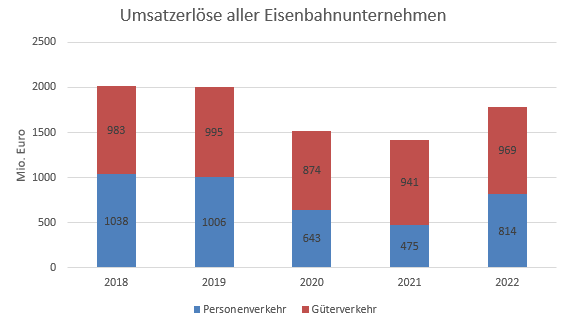
From mid-December 2018, orders for passenger transport services from the federal government and the federal states were consolidated in federal state contracts. In 2023, the federal government ordered a total of 115 million train kilometers in passenger transport, an increase over the previous year. The majority of this was accounted for by ÖBB passenger transport services in commuter traffic. In addition to the ÖBB orders, 13 million train kilometers were ordered from other market participants. Improvements in long-distance transport include new connections between state capitals and increased service frequencies. There were numerous expansions in local transport, resulting in over two million additional timetable kilometers. Federal spending on these services rose to around €1.73 billion in 2023, with the majority benefiting local transport. SCHIG is responsible for billing and monitoring contracts between the federal government and rail transport companies, while other local authorities can order additional transport services.
In order to promote rail freight transport in Austria, the federal government introduced the SGV-Plus program in 2023, consisting of operating cost subsidies and track access charges. These subsidies support various forms of freight transport that require public support due to higher costs compared to road freight transport. Traditional operating cost subsidies are granted for single wagon transport, unaccompanied combined transport (UKV), and rolling highway (RoLa). The subsidy varies depending on the type of transport, container size and weight, and distance traveled. In 2023, the federal government paid a total of €125.9 million in SGV subsidies, with single wagon transport receiving the largest share. In addition to operating cost subsidies, the "manipulated freight transport" segment has been supported by track access charge subsidies since 2020, with rail usage charges being partially suspended. In 2023, a total of €52.1 million was made available for this purpose, mainly for Rail Cargo Austria and its competitors.
Market update April/May 2024
Developments among energy suppliers in the Austrian market
With Easter travel and temporarily over 30 additional train connections, ÖBB began using the new nine-car Railjet2 trains (total capacity: 532 seats). They were first used between Vienna and Feldkirch as reinforcements, and on April 8, they began operating on the Brenner route (two train pairs Munich–Bologna, one Munich–Innsbruck). This in turn freed up vehicle capacity that can be used on the southern route.
ÖBB is constructing a new maintenance hall on the site of the former Vienna-Floridsdorf freight station for the double-decker CityJet trains expected in the eastern region from 2026. The proximity to the newly built storage facility will help to avoid empty runs in the future.
The ERA has issued new, multi-year, uniform safety certificates to DB FV (for PV in AT and DE) and DPB Rail Infra Service (for GV in AT/DE/IT). It has also updated the safety certificate of Rund ums Gleis GmbH for GV in DE, IT, and AT. The railway undertaking most recently operated spot transit services on the Pyhrn-Schober axis between Passau and Spielfeld-Strass.
infrastructure
On April 12, the BMK granted the Salzburg light rail project (S-Link) a 99-year concession. The concession applies to passenger transport on the Salzburg Lokalbahnhof - Hallein route and to possible freight transport from the Leube junction to Hallein. Operations are to be taken over by Salzburg Linien Verkehrsbetriebe.
With the commissioning of the Koralmbahn railway in December 2025, long-distance services on intra-Alpine routes will be reorganized. With the 2025/26 timetable change, several "InterRegio" lines (medium-speed new long-distance trains running every 1-2 hours to serve Alpine regions and optimize connections to other long-distance services) will be introduced. This will significantly improve long-distance transport connections for many Alpine regions, with new direct connections on several routes (e.g., Graz–Klagenfurt via Aichfeld, Graz–Innsbruck via Ennstal, Graz–Linz via Pyhrn, and Salzburg–Wörgl via Zell/See).
As part of an Interreg Central Europe program, Raaberbahn will extend two existing trains from Neusiedl am See to Pamhagen and Sopron on weekends until the end of August, which are intended for bicycle tourists.
Starting with the 2024 timetable change, the Tyrolean S8 will be extended from Hochfilzen to Zell am See, enabling two to three train connections per hour to be offered.
Rail Schienen-Control a new employee
Dr. Beate Gelbmann supports the Schienen-Control team Schienen-Control a project manager and lawyer. With her experience from her work at the Association for Consumer Information (VKI) and various teaching positions at universities and technical colleges Schienen-Control she Schienen-Control an ideal addition to the Schienen-Control team.